
RESEARCH EXPERTISE
Ecological Modelling
Using quantitative approaches to understand, predict, and manage freshwater ecosystems
TURNING ECOLOGICAL DATA INTO INSIGHT
Understanding patterns and anticipating change
Ecological modelling helps us understand complex relationships in freshwater ecosystems and explore how they may respond to environmental change. We combine field observations, environmental and spatial information, and indicators of human activity with statistical models, Bayesian networks, and machine-learning approaches. From predicting angler pressure to examining the spatial organization of fish communities, our goal is to produce defensible evidence that supports fisheries management, monitoring, and freshwater conservation.
STEP 01
Assemble
Bring together biological surveys, environmental measurements, spatial information, and data on human activities.
STEP 02
Model
Use statistical, spatial, Bayesian, and machine-learning methods to investigate relationships and make predictions.
STEP 03
Evaluate
Compare model predictions with observations, assess uncertainty, and translate findings into management insights.
FROM DATA TO DECISIONS
Ecological modelling in practice
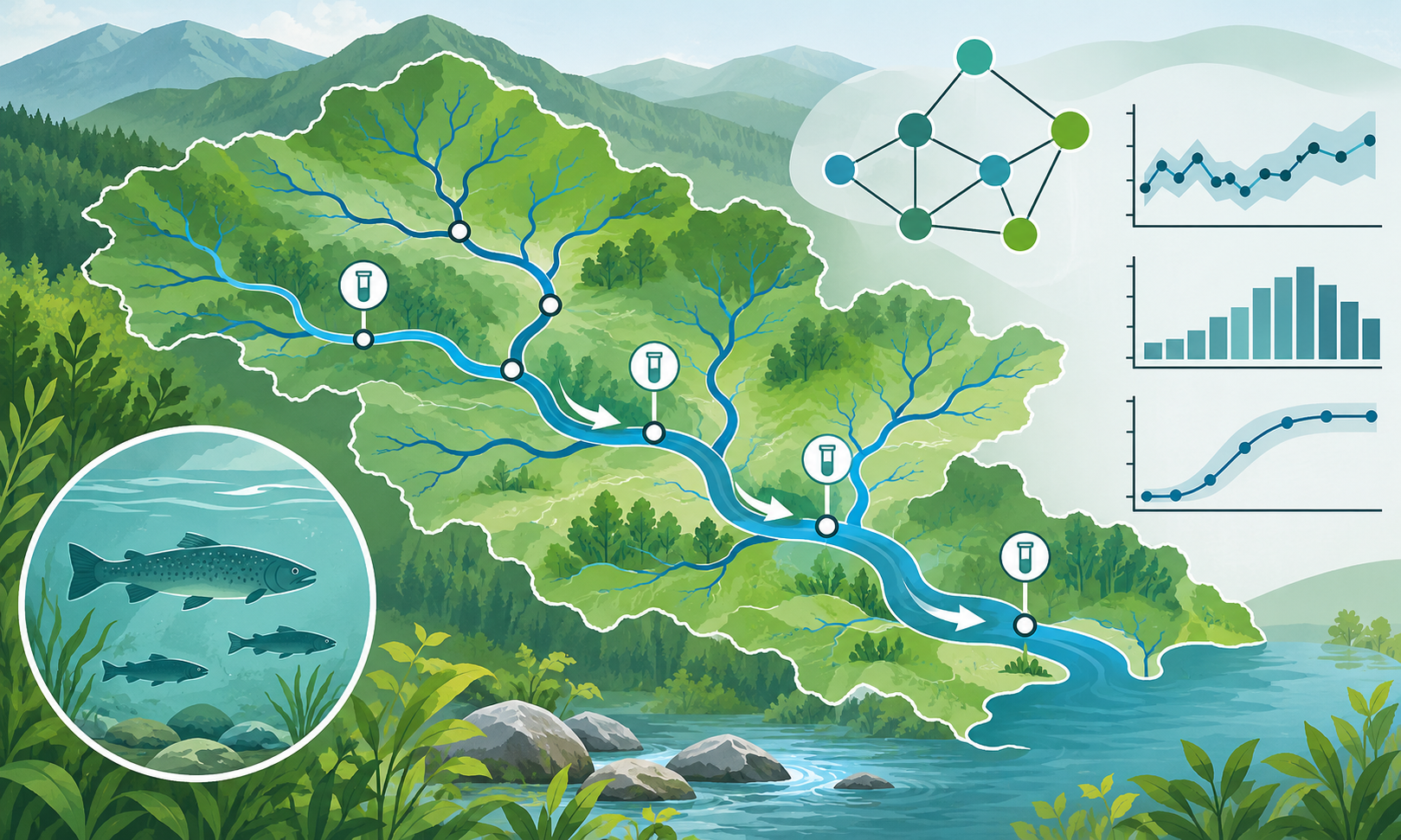
A CONCEPTUAL MODELLING WORKFLOW
1. Ecological observations
Fish surveys, environmental conditions, spatial patterns, and human activity
↓
2. Quantitative models
Statistical analysis, Bayesian networks, spatial models, and machine learning
↓
3. Evidence for decisions
Predictions, uncertainty assessments, conservation planning, and fisheries management
Conceptual workflow for illustration; not a specific study result.
SELECTED PUBLICATIONS
Articles from the Lab
Recent research applying quantitative and spatial approaches to fisheries and freshwater ecosystems.
Comparing literature-guided, LLM-assisted, and data-driven models for predicting angler pressure →
Tayebi, A.T., Schmid J., Simmons S., Poesch, M. S., Lewis M. and P. Ramazi. (2026). PlosOne 21(10): e0357450.
Website visits can predict angler presence using machine learning →
Schmid J., Simmons S., Lewis M., Poesch, M. S. and P. Ramazi. (2026). FACETS 11:1-10.
Website views as a proxy for angler pressure and effort: Insight from Bayesian networks →
Tayebi A. T., Schmid J., Simmons S., Poesch M. S., Ramazi P. and M. Lewis. (2025). Canadian Journal of Fisheries and Aquatic Sciences.
Analyzing fisher effort – Gender differences and the impact of Covid-19 →
Schmid J., Simmons S., Poesch M. S., Ramazi P. and M. Lewis. (2025). Canadian Journal of Fisheries and Aquatic Sciences.
Complexity and spatial structuring of fish communities across urbanized watersheds and waterfronts →
Theis S.*, Chin, A. T.M., Wallace, A., Cartwright L., Fortin M.J., Poesch, M.S. and Ruppert, J.L.W. (2025). Urban Ecosystems 28: 1–18.