Thayer, D.*, Ruppert, J.L.W., Watkinson, D., Clayton, T. and M.S. Poesch. (2017) Identifying temporal bottlenecks for the conservation of large-bodied fishes: Lake Sturgeon (Acipenser fluvescens) show highly restricted movement and habitat-use overwinter. Global Ecology and Conservation 10: 194-205.

Abstract:

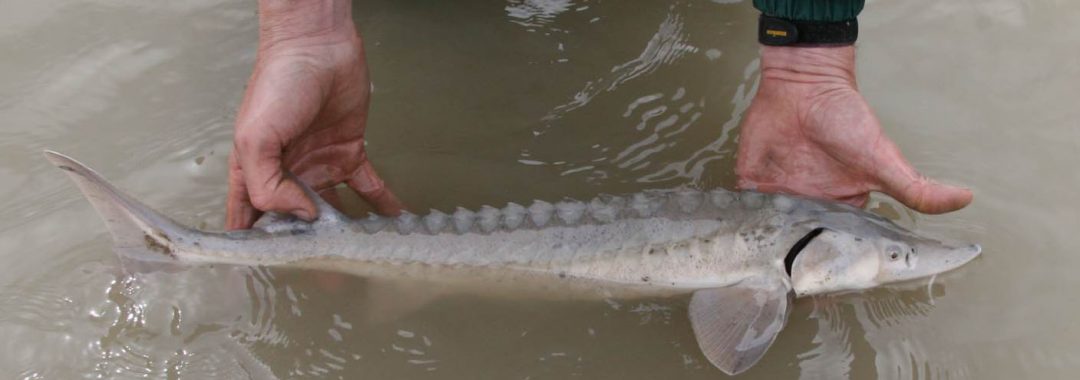
The relationship between species’ size and home range size has been well studied. In practice, home range may provide a good surrogate of broad spatial coverage needed for species conservation, however, many species can show restricted movement during critical life stages, such as breeding and over-wintering. This suggests the existence of either a behavioral or habitat mediated ‘temporal bottleneck,’ where restricted or sedentary movement can make populations more susceptible to harm during specific life stages. Here, we study over-winter movement and habitat use of Lake Sturgeon (Acipenser fulvescens), the largest freshwater fish in North America. We monitored over-winter movement of 86 fish using a hydro-acoustic receiver array in the South Saskatchewan River, Canada. Overall, 20 fish remained within our study system throughout the winter. Lake Sturgeon showed strong aggregation and sedentary movement over-winter, demonstrating a temporal bottleneck. Movement was highly restricted during ice-on periods (ranging from 0.9 km/day in November and April to 0.2 km/day in mid-November to mid-March), with Lake Sturgeon seeking deeper, slower pools. We also show that Lake Sturgeon have strong aggregation behavior, where distance to conspecifics decreased (from 575 to 313 m) in preparation for and during ice-on periods. Although the Lake Sturgeon we studied had access to 1100 kilometers of unfragmented riverine habitat, we show that during the over-winter period Lake Sturgeon utilized a single, deep pool (<0.1% of available habitat). The temporal discrepancy between mobile and sedentary behaviors in Lake Sturgeon suggest adaptive management is needed with more localized focus during periods of temporal bottlenecks, even for large-bodied species.

CitationThayer, D.*, Ruppert, J.L.W., Watkinson, D., Clayton, T. and M.S. Poesch. (2017) Identifying temporal bottlenecks for the conservation of large-bodied fishes: Lake Sturgeon (Acipenser fluvescens) show highly restricted movement and habitat-use overwinter. Global Ecology and Conservation 10: 194-205.

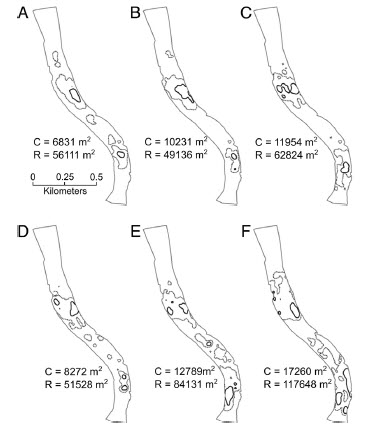
Monthly core (C) and range (R) extent kernel density maps for: A) November, B) December, C) January, D) February, E) March, and F) April. Black lines are core range (50% percentile), broken lines range (90th percentile) extent.

Also Read:

Miller, M., Stevens, C. and M. S. Poesch. (In Press). Effectiveness of Spawning Substrate Enhancement for Adfluvial Fish in a Regulated Sub-Arctic River. River Research and Applications.

*Lab members: Donnette ThayerJonathan RuppertMark Poesch. Check out opportunities in the lab!

Maitland, B.M.*, Anderson, A. and Poesch, M.S. (2016) Prioritising culvert removals to restore habitat for at-risk salmonids in the Boreal forest. Fisheries Management and Ecology 23: 489-502.

Abstract:

Stream crossing structures are an increasingly prevalent anthropogenic feature on North American riverscapes, particularly in watersheds affected by industrial resource development in sensitive boreal environments. If improperly managed, stream crossings have the potential to alter fish habitat and impede fish movement. This study assessed instream habitat characteristics and fish communities from 33 culverted, bridged and reference streams in an industrialising region of the boreal forest in west-central Alberta. Mixed-effects modelling and multivariate analysis were used to determine impacts of stream crossings at three scales: whole-stream scale, within-stream scale and the interaction of scales. Instream habitat characteristics such as mean depth, water velocity, percent fines, turbidity, water temperature and dissolved oxygen showed significant between-stream as well as within-stream differences among stream crossings. The majority of fish species exhibited significantly lower densities (n m−2) in upstream habitats as compared to downstream habitats, including a significant reduction in Slimy Sculpin densities in culverted streams. Multivariate tests corroborated these results, showing that fish assemblages differ as a function of stream type. This study suggests industrial stream crossings influence abiotic habitat characteristics in freshwater ecosystems, restrict biotic connectivity and impact fish community structure at the whole-stream and within-stream scales. Alterations to stream ecosystems associated with stream crossings may be driving large-scale changes in stream fish communities in the boreal forest. With expanded development expected in much of North America’s boreal region, mitigation measures which limit impacts from stream crossings are needed to ensure proper ecosystem function in freshwater systems.

CitationMaitland, B.M.*, Anderson, A. and Poesch, M.S. (2016) Prioritising culvert removals to restore habitat for at-risk salmonids in the Boreal forest. Fisheries Management and Ecology 23: 489-502.

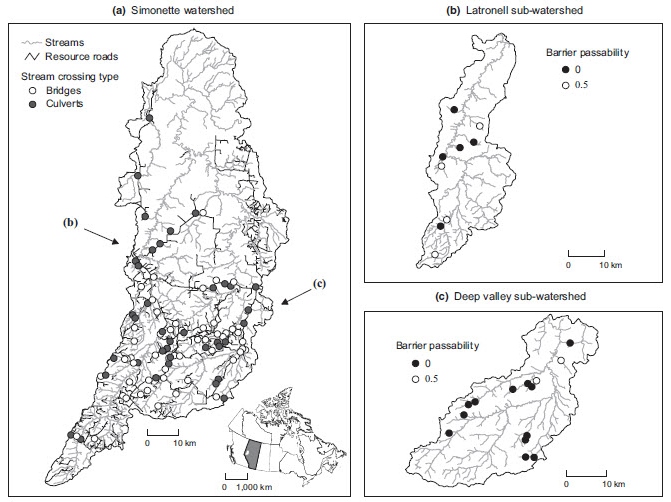
Site Locations of Assessed Stream Crossings, including (a) Simoneete, (b) Latronell and (c) Deep Valley watersheds in Alberta Canada.

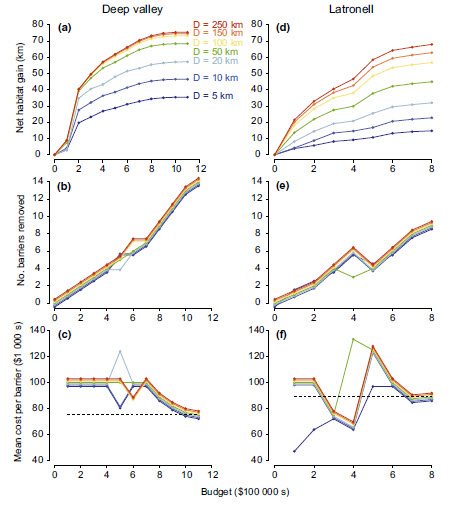
Prioritization given: net habitat gain (a,d), number of barriers removed (c,f) and the mean cost per barrier (c,f) across Deep Valley and Latronell subwatersheds.

Also Read:

Medinski, N.A.*, Maitland, B.M.*, Jardine, T.D., Drake, D.A.R. and M.S. Poesch (2022) A catastrophic coal mine spill in the Athabasca River watershed induces isotopic niche shifts in stream biota including an endangered rainbow trout ecotype. Canadian Journal for Fisheries and Aquatic Sciences 79(8): 1321-1334.

*Lab members: Bryan MaitlandMark Poesch. Check out opportunities in the lab!

Alberta Conservation Association funds alpine fisheries research

The Alberta Conservation Association provided a grant to help research the impact of stocking of non-native trout on alpine ecosystems. This project is being led by MSc student Allison Banting with the help of Dr. Mark Taylor and Rolf Vinebrooke. Thanks ACA for your continued support of the PoeschLab.

Maitland, B. (2015) Stream Crossings in the Western Boreal Forest: Assessing Impacts and Prioritizing Restoration for Native Freshwater Fishes

Thesis Title: Stream Crossings in the Western Boreal Forest: Assessing Impacts and Prioritizing Restoration for Native Freshwater Fishes

AuthorBryan M. Maitland

Abstract

Growing anthropogenic development in response to rising demands for natural resources is a major concern for freshwater fish, particularly in resource rich regions such as Canada’s boreal forest. Expanding networks of industrial resource roads has led to the installation of hundreds of thousands of stream-crossing structures that are becoming increasingly common anthropogenic features on North American riverscapes. These structures can reduce available fish habitat, deteriorate instream habitat, and disrupt ecological connectivity by acting as barriers to fish and aquatic organism movement. My objectives were (i) to determine the extent to which commonly installed stream crossings affect stream fish communities in a boreal forest watershed, and (ii) to assess the application of operational research tools that utilize an optimization framework for mitigating the effects of fragmentation on native freshwater fish and informing restoration planning in the boreal forest. I used mixed-effects modeling and multivariate analyses to determine the effects of stream crossings from 33 culverted, bridged, and reference streams in an industrializing region of the boreal forest in west-central Alberta. Instream habitat characteristics such as mean depth, percent fines, and turbidity showed significant between- as well as within-stream differences among stream crossings. I found that the majority of fish species exhibited significantly lower densities (n·m -2) in upstream habitats as compared to downstream habitats, including a significant reduction in Slimy Sculpin densities in streams with culverts compared to reference streams. Multivariate tests showed that fish assemblages differ as a function of stream type and location. The prioritization method utilized in this study suggests that large gains in potential connectivity could be realized with a moderate investment (~$200K to $500K). I found that the operational research tool can be used to develop cost-benefit curves from the study watersheds, which can be used to minimize overall restoration costs to achieve particular management objectives in watersheds of interest, as well as provide defendable evidence for budget planning to regulators and decision-makers. Additionally, varying model parameters that account for species-specific differences in habitat use (e.g. dispersal distance) affected prioritization solutions, and should be considered in future prioritization analyses. In addition to effecting fish passage and stream connectivity, my results suggest that culverts may also be altering fish habitat, further contributing to large-scale changes in stream fish communities in the boreal forest. Further, my research highlights the efficacy of a novel, easy to use optimization-based barrier prioritization toolset that has minimal data requirements, is applicable to both stream-resident and long-range migratory species, and significantly reduces the mathematical and technical expertise needed to perform relatively complex optimization analyses.

Poesch, M.S., Walker, S.C., and D.A. Jackson (2009) Functional diversity indices can be driven by methodological choices and species richness. Ecology 90(2): 341-346.

Abstract:

Functional diversity is an important concept in community ecology because it captures information on functional traits absent in measures of species diversity. One popular method of measuring functional diversity is the dendrogram-based method, FD. To calculate FD, a variety of methodological choices are required, and it has been debated about whether biological conclusions are sensitive to such choices. We studied the probability that conclusions regarding FD were sensitive, and that patterns in sensitivity were related to alpha and beta components of species richness. We developed a randomization procedure that iteratively calculated FD by assigning species into two assemblages and calculating the probability that the community with higher FD varied across methods. We found evidence of sensitivity in all five communities we examined, ranging from a probability of sensitivity of 0 (no sensitivity) to 0.976 (almost completely sensitive). Variations in these probabilities were driven by differences in alpha diversity between assemblages and not by beta diversity. Importantly, FD was most sensitive when it was most useful (i.e., when differences in alpha diversity were low). We demonstrate that trends in functional-diversity analyses can be largely driven by methodological choices or species richness, rather than functional trait information alone.

Citation: Poesch, M.S., Walker, S.C., and Jackson, D.A. 2009. Functional diversity indices can be driven by methodological choices and species richness. Ecology 90(2): 341-346.

Also Read:

Theis, S.*, Ruppert, J.*, Shirton, J.* and M.S. Poesch (2022) Measuring beta diversity components and beneficial effects of coarse woody habitat introduction on invertebrate and macrophyte communities in a shallow northern boreal lake: implications for offsetting. Aquatic Ecology 56: 793-814.

Poesch, M.S., Mandrak, N.E., and R. L. McLaughlin (2008) A practical framework for selecting among single species, multi-species and ecosystem-based recovery plans. Canadian Journal for Fisheries & Aquatic Science 65: 2656-2666.

Abstract:

Science-based approaches for selecting among single-species, community-, and ecosystem-based recovery plans are needed to conserve imperilled species. Selection of recovery plans has often been based on past success rates with other taxa and systems or on economic cost, but less on the ecology of the system in question. We developed a framework for selecting a recovery plan based on the distributions and ecology of imperilled and nonimperilled species across available habitat types and applied it to fishes in the Sydenham River, Ontario, Canada. We first tested whether distributions of fishes were adequately predicted by habitat features hypothesized to limit the distributions of imperilled fishes versus a broader set of habitat features known to predict fish distributions. We then tested whether imperilled species occurred in similar or disparate habitat types. For the Sydenham River, an ecosystem-based recovery plan was deemed most appropriate because imperilled species occur in disparate habitat types. We lastly provide decision criteria to facilitate applications of our framework to the selection of recovery plans for other species and systems.

Citation: Poesch, M.S., Mandrak, N.E., and McLaughlin, R.L. 2008. A practical framework for selecting among single species, multi-species and ecosystem-based recovery plans. Canadian Journal for Fisheries & Aquatic Science 65: 2656-2666.

Also Read:

Castaneda, R.A., Ackerman, J.D., Chapman, L.J., Cooke, S.J., Cuddington, K., Dextrase, A., Jackson, D.A., Koops, M.A., Krkosek, M., Loftus, K., Mandrak, N.E., Martel, A.L., Molnar, P., Morris, T.J., Pitcher, T.E., Poesch, M.S., Power, M., Pratt, T.C., Reid, S.M., Rodriguez, M.A., Rosenfeld, J., Wilson, C., Zanatta, D.T. and D.A.R. Drake. (2021) Approaches and research needs for advancing the protection and recovery of imperilled freshwater fishes and mussels in Canada. Canadian Journal of Fisheries and Aquatic Sciences 78 (9): 1356-1370.